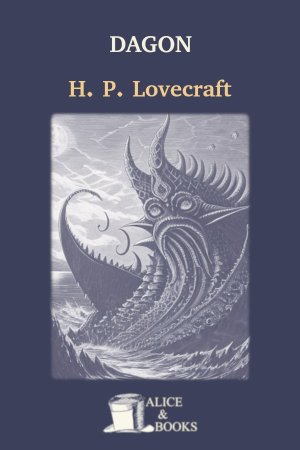
Dagon
Dagon is a horror short story written by H. P. Lovecraft and originally published in 1919.
The first-person narrator is a supercargo aboard a merchant ship captured by a German sea-raider during World War I. After escaping alone in a small boat, he drifts across the Pacific.
When he wakes after a long drift, his boat is stranded on a vast expanse of black mud that has risen from the ocean floor. Exploring the desolate landscape, he finds an ancient monolith and witnesses a colossal sea creature—an experience that drives him to the brink of insanity.
One of Lovecraft’s early cosmic-horror stories, Dagon combines wartime isolation, the terror of unexplored depths, and the limits of human reason. Its images of an ancient marine civilization anticipate ideas that recur in later works such as The Shadow over Innsmouth.
"I am writing this under an appreciable mental strain, since by tonight I shall be no more. Penniless, and at the end of my supply of the drug which alone makes life endurable, I can bear the torture no longer; and shall cast myself from this garret window into the squalid street below."
Your download has started
PDF · Dagon — didn't start? Download again
Also available: PDF · EPUB · MOBI · Read online
Read it on a Kindle
Download the EPUB and send it with Amazon's Send to Kindle (web, app, or your kindle.com email). Modern Kindles accept EPUB directly — no conversion needed.
On iPhone or iPad
Tap the downloaded file, then "Open in Books". It opens in Apple Books, with your reading progress synced across your devices.
On Android
Open the file with Google Play Books or any EPUB reader (ReadEra, Moon+ Reader). PDFs open in any viewer.
On your computer
PDFs open anywhere. For EPUB, try Calibre or Thorium Reader — both free and excellent.
Public domain (US)·No sign-up·DRM-free·Real text, not scans
Copyright note. Dagon by H. P. Lovecraft is believed to be in the public domain in the United States only. It may still be copyrighted in other countries. If you are not in the United States, please check your local laws to ensure this eBook is in the public domain in your country before downloading Dagon in PDF or EPUB.
- Pages
- 12
- Reading time
- 11 minutes
- Pace
- Intermediate
- First published
- 1919
- Language
- English
- Downloads
- 3,217
107 years later, still timely
Why Read Dagon in 2026?
A shipwrecked survivor writes a confession about something seen on a barren reef—an encounter that will not fit the categories he trusts. "Dagon" is a twelve-page plunge into dread, memory, and the mind's need to explain. It is ideal when you want the chill without the sprawl.
Today's connection
Short forms suit crowded days. This tale models uncertainty honestly: testimony wavers, images linger, and the terror is not just the thing but the thinking. Sea, isolation, and obsession make a clean laboratory for fear. You get the essence of cosmic horror in a single sitting.
Sea as witness
The ocean isolates and magnifies the strange. Setting becomes a pressure chamber.
Images you cannot file
Visions exceed the narrator's categories. The story sits where language frays.
Confession as frame
A written account makes you weigh credibility while you feel the pull of obsession.
Share this book
About the author

H. P. Lovecraft
Cosmic horror and a shared mythos that reshaped modern weird fiction and pop culture.