Flatland: A Romance of Many Dimensions
Flatland: A Romance of Many Dimensions is a novel written by Edwin Abbott Abbott in 1884.
The novel describes a world that exists in two dimensions, called Flatland. The inhabitants of this world are geometric shapes, such as triangles or squares, and they move by sliding across the surface of their world.
One day, a being from a three-dimensional world visits Flatland and shows one of its inhabitants what existence is like in three dimensions. This is very confusing for any inhabitant of Flatland, who have never imagined such a thing.
The book is an allegory of the way people can be limited by their own perspective. It is also a satire of Victorian social conventions.
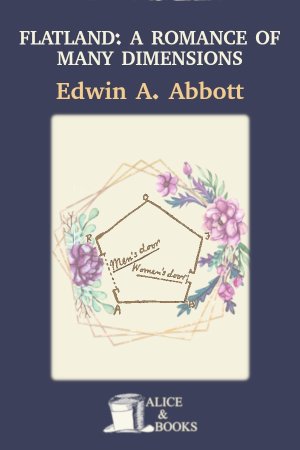
This book is illustrated with original drawings.
"I call our world Flatland, not because we call it so, but to make its nature clearer to you, my happy readers, who are privileged to live in Space.
Imagine a vast sheet of paper on which straight Lines, Triangles, Squares, Pentagons, Hexagons, and other figures, instead of remaining fixed in their places, move freely about, on or in the surface, but without the power of rising above or sinking below it, very much like shadows—only hard and with luminous edges—and you will then have a pretty correct notion of my country and countrymen. Alas, a few years ago, I should have said "my universe": but now my mind has been opened to higher views of things".
Your download has started
PDF · Flatland: A Romance of Many Dimensions — didn't start? Download again
Also available: PDF · EPUB · MOBI · Read online
Read it on a Kindle
Download the EPUB and send it with Amazon's Send to Kindle (web, app, or your kindle.com email). Modern Kindles accept EPUB directly — no conversion needed.
On iPhone or iPad
Tap the downloaded file, then "Open in Books". It opens in Apple Books, with your reading progress synced across your devices.
On Android
Open the file with Google Play Books or any EPUB reader (ReadEra, Moon+ Reader). PDFs open in any viewer.
On your computer
PDFs open anywhere. For EPUB, try Calibre or Thorium Reader — both free and excellent.
Public domain (US)·No sign-up·DRM-free·Real text, not scans
Copyright note. Flatland: A Romance of Many Dimensions by Edwin Abbott Abbott is believed to be in the public domain in the United States only. It may still be copyrighted in other countries. If you are not in the United States, please check your local laws to ensure this eBook is in the public domain in your country before downloading Flatland: A Romance of Many Dimensions in PDF or EPUB.
- Pages
- 100
- Reading time
- 2 hours 56 minutes
- Pace
- Intermediate
- First published
- 1884
- Language
- English
142 years later, still timely
Why Read Flatland in 2026?
A two-dimensional square learns to imagine depth— and we learn how assumptions make prisons. Part math fable, part social satire, it sharpens perspective for science, design, and everyday arguments. Short, strange, and surprisingly durable.
Today's connection
Excellent for classrooms, makers, and skeptics. It turns abstraction playful, then unsettling, and ends by training your eye for unseen dimensions—literal and social.
Thought experiment
Geometry as story.
Satire of rank
Angles of power revealed.
Perspective shift
See beyond the given.
Share this book
About the author
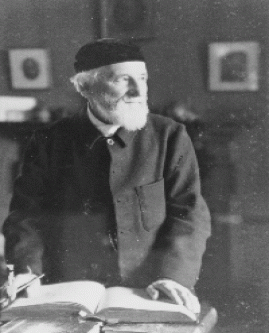
Edwin Abbott Abbott
Geometric satire and social thought; dimensions used to test class and dogma.