
The Brothers Karamazov
The Brothers Karamazov is a philosophical and psychological novel by Fyodor Dostoevsky, serialized from 1879 to 1880. It was the final novel he completed.
Set in 19th-century Russia, the novel deals with ethical debates about the existence of God, free will, and morality, presenting a series of moral struggles in the midst of a modernizing Russia.
The novel centers on the murder of Fyodor Pavlovich Karamazov, father of three acknowledged sons and the probable father of his servant Smerdyakov, and on the investigation and trial that follow.
Suspicion falls on Dmitri, the only son from his father’s first marriage, because of his public quarrels with Fyodor over money and their rivalry for Grushenka. The case draws his brothers Ivan and Alyosha into questions of guilt, responsibility, faith, and justice.
The novel combines psychological ambiguity with a wide-ranging portrait of Russian society of the time. The characters are pushed to moral and psychological extremes, and the story delves into the nature of evil.
This digital edition of the book The Brothers Karamazov is based on Constance Garnett's translation.
Your download has started
PDF · The Brothers Karamazov — didn't start? Download again
Also available: PDF · EPUB · MOBI · Read online
Read it on a Kindle
Download the EPUB and send it with Amazon's Send to Kindle (web, app, or your kindle.com email). Modern Kindles accept EPUB directly — no conversion needed.
On iPhone or iPad
Tap the downloaded file, then "Open in Books". It opens in Apple Books, with your reading progress synced across your devices.
On Android
Open the file with Google Play Books or any EPUB reader (ReadEra, Moon+ Reader). PDFs open in any viewer.
On your computer
PDFs open anywhere. For EPUB, try Calibre or Thorium Reader — both free and excellent.
Public domain (US)·No sign-up·DRM-free·Real text, not scans
Copyright note. The Brothers Karamazov by Fyodor Dostoevsky is believed to be in the public domain in the United States only. It may still be copyrighted in other countries. If you are not in the United States, please check your local laws to ensure this eBook is in the public domain in your country before downloading The Brothers Karamazov in PDF or EPUB.
- Pages
- 852
- Reading time
- 29 hours 16 minutes
- Pace
- Intermediate
- First published
- 1880
- Language
- Russian
- Downloads
- 13,595
146 years later, still timely
Why Read The Brothers Karamazov in 2026?
A family quarrel becomes an inquiry into freedom, responsibility, and belief. "The Brothers Karamazov" is a giant of conversations—taverns, cells, kitchens—where arguments feel lived, not staged. It is generous to doubt and strict about consequences. Long, yes; but it teaches how to think without losing heart.
Today's connection
For polarized debates, the novel offers patience and depth. It stages faith, skepticism, and justice without reducing anyone to a straw figure. Courtroom scenes and private confessions test what words are worth. You finish willing to ask better questions and to carry their weight.
Dialogues as arenas
Ideas fight fair across scenes and voices. No single perspective owns the truth.
Case and conscience
Investigation frames moral inquiry. Evidence and motive keep shifting under light.
Family as laboratory
Love, resentment, and duty collide. Philosophy stays attached to people.
These collections include The Brothers Karamazov



Best Books of the 19th Century
The century’s defining works—from Gothic shadows and social epics to radical experiments in style.
Explore the collection →


Must Read Russian Classics
Moral dilemmas and vast inner lives — and eight of these are under eighty pages.
Explore the collection →Share this book
About the author
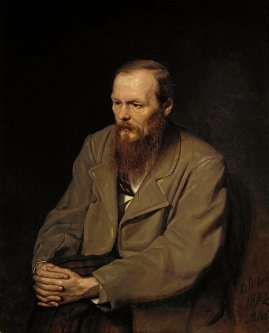
Fyodor Dostoevsky
Psychological depth and moral crisis under pressure; fiction that tests conscience, freedom, and society.
If this one stays with you…

The Voyage OutVirginia Woolf

Jacob's RoomVirginia Woolf

UlyssesJames Joyce

Pierre et JeanGuy de Maupassant
From The Brothers Karamazov
People talk sometimes of bestial cruelty, but that’s a great injustice and insult to the beasts; a beast can never be so cruel as man, so artistically cruel.
Man is broad, too broad. I’d have him narrower.
As a general rule, people, even the wicked, are much more naïve and simple-hearted than we suppose. And we ourselves are, too.
This is something about which You were right. For the mystery of human existence lies not in just staying alive, but in finding something to live for. Without a concrete idea of what he is living for, man would refuse to live, would rather exterminate himself than remain on this earth, even if bread were scattered all around him.
What is the use of Christ's words, unless we set an example?