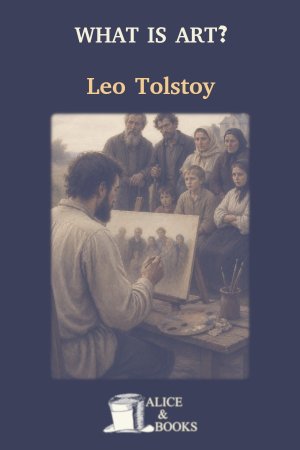
What Is Art?
What Is Art? is a philosophical treatise written by Leo Tolstoy in 1897 and first published in 1898.
In the book, Tolstoy examines the meaning and purpose of art, rejecting the idea that it should be defined primarily by beauty, pleasure, or technical excellence. Instead, he argues that art is a means of communicating feelings from one person to another.
Tolstoy criticizes much of the art admired by wealthy and educated audiences, claiming that it is often artificial, inaccessible, and separated from ordinary life. For a work to be genuine, it must express emotion sincerely and create a shared human experience that can unite people across social and cultural divisions.
Combining aesthetics, religion, and social criticism, the treatise presents a demanding vision of artistic responsibility. Tolstoy concludes that the highest art should be understandable to everyone and should promote compassion, brotherhood, and the moral improvement of humanity.
""
This edition is based on the English translation by Aylmer Maude.
Your download has started
PDF · What Is Art? — didn't start? Download again
Also available: PDF · EPUB · Read online
Read it on a Kindle
Download the EPUB and send it with Amazon's Send to Kindle (web, app, or your kindle.com email). Modern Kindles accept EPUB directly — no conversion needed.
On iPhone or iPad
Tap the downloaded file, then "Open in Books". It opens in Apple Books, with your reading progress synced across your devices.
On Android
Open the file with Google Play Books or any EPUB reader (ReadEra, Moon+ Reader). PDFs open in any viewer.
On your computer
PDFs open anywhere. For EPUB, try Calibre or Thorium Reader — both free and excellent.
Public domain (US)·No sign-up·DRM-free·Real text, not scans
Copyright note. What Is Art? by Leo Tolstoy is believed to be in the public domain in the United States only. It may still be copyrighted in other countries. If you are not in the United States, please check your local laws to ensure this eBook is in the public domain in your country before downloading What Is Art? in PDF or EPUB.
- Pages
- 231
- Reading time
- 6 hours 43 minutes
- Pace
- intermediate
- Language
- Russian
A classic that still feels modern
Why Read What Is Art? in 2026?
Tolstoy turns on the art establishment and asks what art is actually for. His answer — the sincere transmission of feeling, understandable to everyone — dismisses much of what wealthy audiences admire. It's aesthetics written as a moral challenge.
Today's connection
Arguments about elitist art, authenticity, and who culture is for have never gone quiet. Tolstoy's demanding standard is a bracing test to hold against anything you love.
Art as feeling
Emotion sincerely transmitted.
Against pretension
Elite taste on trial.
Living provocation
Argue with every page.
Share this book
About the author

Leo Tolstoy
Epic realism with intimate ethics; the cadence of daily life turned into vision and care.