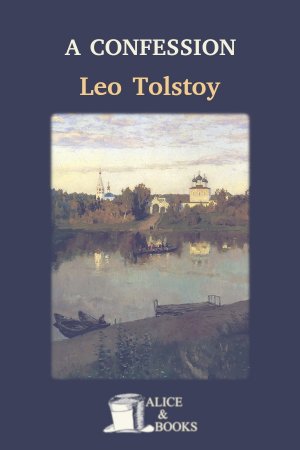
A Confession
A Confession is an autobiographical and philosophical work by Leo Tolstoy, written in 1879–80 and first published in Geneva in 1884 after its planned Russian publication was suppressed.
Tolstoy recounts an existential crisis that brought him close to suicide despite his literary success and family life. He examines his struggles with faith and doubt and the search that led him toward the religious faith he observed among ordinary working people.
Throughout the work, Tolstoy tests the answers offered by science, philosophy, and religious tradition against the problem of how life can have meaning in the face of death. A Confession is both a candid account of his inner crisis and a work of spiritual exploration.
This edition of A Confession is based on the English translation by Aylmer Maude.
Your download has started
PDF · A Confession — didn't start? Download again
Also available: PDF · EPUB · MOBI · Read online
Read it on a Kindle
Download the EPUB and send it with Amazon's Send to Kindle (web, app, or your kindle.com email). Modern Kindles accept EPUB directly — no conversion needed.
On iPhone or iPad
Tap the downloaded file, then "Open in Books". It opens in Apple Books, with your reading progress synced across your devices.
On Android
Open the file with Google Play Books or any EPUB reader (ReadEra, Moon+ Reader). PDFs open in any viewer.
On your computer
PDFs open anywhere. For EPUB, try Calibre or Thorium Reader — both free and excellent.
Public domain (US)·No sign-up·DRM-free·Real text, not scans
Copyright note. A Confession by Leo Tolstoy is believed to be in the public domain in the United States only. It may still be copyrighted in other countries. If you are not in the United States, please check your local laws to ensure this eBook is in the public domain in your country before downloading A Confession in PDF or EPUB.
- Pages
- 79
- Reading time
- 2 hours 11 minutes
- Pace
- Intermediate
- First published
- 1880
- Language
- Russian
- Downloads
- 6,304
146 years later, still timely
Why Read A Confession in 2026?
A famous novelist admits success did not answer the hardest question—what makes a life worth living? “A Confession” is Tolstoy’s clear, uncomfortable self-audit: doubt, despair, and a turn toward simple faith and work. Brief, bracing, and unexpectedly tender.
Today's connection
This is not sermon but inventory. Tolstoy tests philosophies, pleasures, and prestige, then listens to ordinary people whose lives still feel coherent. Readers today can use it as a template for their own audits: write down assumptions, examine outcomes, and try practices that lower vanity and raise care. Whether religious or not, you may find his practical steps—manual labor, family closeness, attention to need—oddly stabilizing. Read it alongside a journal; mark the pages that nudge gentleness.
Clarity before answers
Naming the void reduces panic; questions become workable.
Tested practice
Small disciplines—not drama—rebuild meaning.
Humility helps
Listening to simple lives corrects clever despair.
These collections include A Confession



Must Read Russian Classics
Moral dilemmas and vast inner lives — and eight of these are under eighty pages.
Explore the collection →
Classics Under 100 Pages
Short enough to finish today — and none of them minor. Page count and reading time on every card.
Explore the collection →Share this book
About the author

Leo Tolstoy
Epic realism with intimate ethics; the cadence of daily life turned into vision and care.
If this one stays with you…
The PrinceNiccolò Machiavelli
MeditationsMarcus Aurelius

LeviathanThomas Hobbes
CandideVoltaire
From A Confession
The only absolute knowledge attainable by man is that life is meaningless.
I do not live when I loose belief in the existence of God. I should long ago have killed myself had I not had a dim hope of finding Him. I live really live only when I feel him and seek Him.
Wrong does not cease to be wrong because the majority share in it.
I did not myself know what I wanted: I feared life, desired to escape from it, yet still hoped something of it.
The assertion that you are in falsehood and I am in truth ist the most cruel thing one man can say to another.