A Journal of the Plague Year
A Journal of the Plague Year is Daniel Defoe's 1722 reconstruction of the Great Plague that struck London in 1665. Written decades after the event, it adopts the voice of an eyewitness identified only by the initials H. F. and occupies an unsettled space between novel, chronicle, and documentary history.
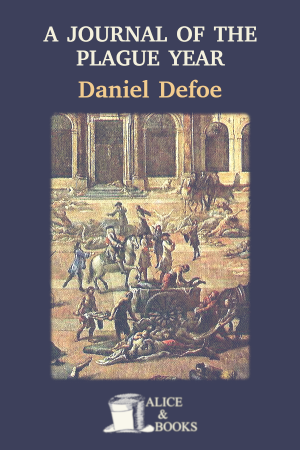
H. F. remains in the city as infection spreads from parish to parish. He follows the weekly bills of mortality, observes houses being shut up, burial pits filling, trade collapsing, and families deciding whether to flee, while rumors and false cures circulate beside official orders.
Statistics and street-level anecdotes continually correct one another. The narrator considers providence, civic policy, poverty, fear, and self-preservation, but also records the practical kindness and endurance that survive in a city organized around contagion.
Defoe's accumulation of dates, places, testimony, and uncertainty gives the book its extraordinary realism. Its power lies partly in never allowing the reader a simple boundary between reported fact and imaginative reconstruction.
"It was about the beginning of September, 1664, that I, among the rest of my neighbours, heard in ordinary discourse that the plague was returned again in Holland; for it had been very violent there, and particularly at Amsterdam and Rotterdam, in the year 1663, whither, they say, it was brought, some said from Italy, others from the Levant, among some goods which were brought home by their Turkey fleet; others said it was brought from Candia; others from Cyprus. It mattered not from whence it came; but all agreed it was come into Holland again."
Your download has started
PDF · A Journal of the Plague Year — didn't start? Download again
Also available: PDF · EPUB · MOBI · Read online
Read it on a Kindle
Download the EPUB and send it with Amazon's Send to Kindle (web, app, or your kindle.com email). Modern Kindles accept EPUB directly — no conversion needed.
On iPhone or iPad
Tap the downloaded file, then "Open in Books". It opens in Apple Books, with your reading progress synced across your devices.
On Android
Open the file with Google Play Books or any EPUB reader (ReadEra, Moon+ Reader). PDFs open in any viewer.
On your computer
PDFs open anywhere. For EPUB, try Calibre or Thorium Reader — both free and excellent.
Public domain (US)·No sign-up·DRM-free·Real text, not scans
Copyright note. A Journal of the Plague Year by Daniel Defoe is believed to be in the public domain in the United States only. It may still be copyrighted in other countries. If you are not in the United States, please check your local laws to ensure this eBook is in the public domain in your country before downloading A Journal of the Plague Year in PDF or EPUB.
- Pages
- 214
- Reading time
- 8 hours 0 minutes
- Pace
- Intermediate
- First published
- 1722
- Language
- English
- Downloads
- 2,672
304 years later, still timely
Why Read A Journal of the Plague Year in 2026?
Ledger entries, street reports, and whispered fears bring a city under contagion to life. Defoe balances data with scenes, tracing quarantine, migration, charity, and fraud. The voice stays steady, which makes the panic more believable and the humanity more durable.
Today's connection
After recent pandemics, it reads like a field manual for information hygiene, mutual aid, and institutional memory.
Crisis reporting
Numbers and neighbors.
Rumor mechanics
What spreads besides disease.
City as organism
Systems under stress.
Share this book
About the author

Daniel Defoe
Survival, trade, and voice that invented a modern reality effect on the page.