Siddhartha
Siddhartha is an allegorical novel written by Hermann Hesse and published in 1922. The novel tells us about the life of a Hindu, son of a Brahman, named Siddhartha.
Siddhartha searches for his path in life accompanied by Govinda, his best friend. Both decide to spend some time with wandering ascetics known as Samanas, so they leave their families.
These men live with hardly any material possessions, meditating and surviving with what they find along the way. With them, the boys learn to meditate and fast.
After spending some time with the Samanas, they decide to go see Buddha (Gotama). There Govinda decides to join the group, so Siddhartha must follow his path alone, traveling alone to a city where he will meet the young and beautiful Kamala, a fact that will change everything...
The novel unifies lyrical and epic elements, including narration and meditation, and at the same time, stark sensuality.
This digital edition of the book Siddhartha is based on the transcript found in Project Gutenberg. The translators are Gunther Olesch, Anke Dreher, Amy Coulter, Stefan Langer and Semyon Chaichenets.
Your download has started
PDF · Siddhartha — didn't start? Download again
Also available: PDF · EPUB · MOBI · Read online
Read it on a Kindle
Download the EPUB and send it with Amazon's Send to Kindle (web, app, or your kindle.com email). Modern Kindles accept EPUB directly — no conversion needed.
On iPhone or iPad
Tap the downloaded file, then "Open in Books". It opens in Apple Books, with your reading progress synced across your devices.
On Android
Open the file with Google Play Books or any EPUB reader (ReadEra, Moon+ Reader). PDFs open in any viewer.
On your computer
PDFs open anywhere. For EPUB, try Calibre or Thorium Reader — both free and excellent.
Public domain (US)·No sign-up·DRM-free·Real text, not scans
Copyright note. Siddhartha by Hermann Hesse is believed to be in the public domain in the United States only. It may still be copyrighted in other countries. If you are not in the United States, please check your local laws to ensure this eBook is in the public domain in your country before downloading Siddhartha in PDF or EPUB.
- Pages
- 102
- Reading time
- 3 hours 18 minutes
- Pace
- Intermediate
- First published
- 1922
- Language
- German
- Downloads
- 19,143
104 years later, still timely
Why Read Siddhartha in 2026?
A quiet book that moves like a river, "Siddhartha" follows one life through teachers, pleasures, work, loss, and listening. It does not sell enlightenment; it shows attention maturing. Spare, musical prose makes room for readers to notice restlessness, try disciplines, and learn from ordinary days. You close it with fewer slogans and a clearer ear.
Today's connection
In an overstimulated year, the novel models patient experiment: apprenticeships, mistakes, and the courage to begin again. It honors multiple paths without relativism. The river becomes a teacher in time, silence, and compassion. Practical, humane, and brief, it suits a chapter before bed better than another scroll.
Apprenticeship of attention
Listening—first to teachers, then to life—becomes the craft. The book shows how perception ripens.
Many paths, one life
Discipline, commerce, love, solitude: each phase teaches something different. No single route owns wisdom.
River as teacher
Nature is not backdrop; it is method. Time, flow, and return give form to insight.
Share this book
About the author
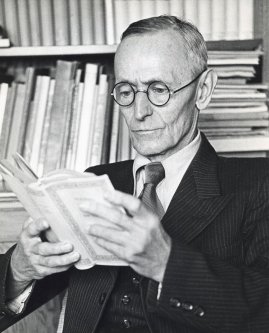
Hermann Hesse
Spiritual quests and identity under pressure; calm prose for restless lives.
If this one stays with you…

From Siddhartha
Wisdom cannot be imparted. Wisdom that a wise man attempts to impart always sounds like foolishness to someone else ... Knowledge can be communicated, but not wisdom. One can find it, live it, do wonders through it, but one cannot communicate and teach it.
You, Venerable One, may indeed be a seeker, for, striving toward your goal, there is much you do not see which is right before your eyes.
And—such is my thinking, o Exalted One—no one attains deliverance through teaching!
To listen with a still heart, with a waiting, open soul, without passion, without desire, without judgment, without opinions.
Siddhartha has one single goal-to become empty, to become empty of thirst, desire, dreams, pleasure and sorrow-to let the Self die. No longer to be Self, to experience the peace of an emptied heart, to experience pure thought-that was his goal.