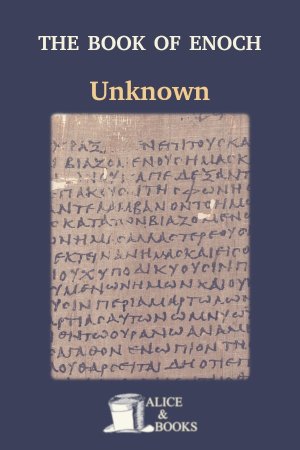
The Book of Enoch
The Book of Enoch is an ancient Hebrew apocalyptic religious text attributed by tradition to Enoch, the great-grandfather of Noah. The earliest portions are generally dated to the third or second century BC, with later sections composed around the first century BC.
The book contains passages on the origins of demons and Nephilim, explains why some angels fell from heaven, the Genesis flood as an act of divine judgment, and a prophetic exposition of the thousand-year reign of the Messiah.
It is part of the biblical canon of the Ethiopian and Eritrean Orthodox Tewahedo Churches, but is not recognized as canonical by most Jewish or Christian traditions.
The book consists of five rather distinct main sections:
- The Book of the Watchers: It describes the fall of the Watchers, the angels who spawned the Nephilim, and narrates the travels of Enoch in the heavens.
- The Book of Parables of Enoch: It is centered on the idea of doomsday and the end of the world.
- The Astronomical Book: It contains descriptions of the motion of celestial bodies and of the firmament.
- The Book of Dream Visions: It deals with dream visions that contain a symbolic account of Israel's history up to what has been interpreted as the Maccabean revolt around 150 BC.
- The Epistle of Enoch: It speaks of various topics such as the history of the world, the righteousness spoken by Enoch, the wisdom of the Lord, the flood and Noah.
Studies indicate that these five parts were originally independent works and that they were later collected in this work known as The Book of Enoch.
This edition of The Book of Enoch is based on the translation by R. H. Charles.
Your download has started
PDF · The Book of Enoch — didn't start? Download again
Also available: PDF · EPUB · MOBI · Read online
Read it on a Kindle
Download the EPUB and send it with Amazon's Send to Kindle (web, app, or your kindle.com email). Modern Kindles accept EPUB directly — no conversion needed.
On iPhone or iPad
Tap the downloaded file, then "Open in Books". It opens in Apple Books, with your reading progress synced across your devices.
On Android
Open the file with Google Play Books or any EPUB reader (ReadEra, Moon+ Reader). PDFs open in any viewer.
On your computer
PDFs open anywhere. For EPUB, try Calibre or Thorium Reader — both free and excellent.
Public domain (US)·No sign-up·DRM-free·Real text, not scans
Copyright note. The Book of Enoch by Unknown is believed to be in the public domain in the United States only. It may still be copyrighted in other countries. If you are not in the United States, please check your local laws to ensure this eBook is in the public domain in your country before downloading The Book of Enoch in PDF or EPUB.
- Pages
- 215
- Reading time
- 3 hours 58 minutes
- Pace
- Intermediate
- First published
- 300
- Language
- Ge'ez
- Downloads
- 10,372
1726 years later, still timely
Why Read The Book of Enoch in 2026?
Ancient visions of angels, watchers, and journeys through layered heavens—"The Book of Enoch" is a key window into early Jewish imagination. Read it as literature and source: symbolic, composite, and influential far beyond its canon status. It is less about prediction than about how communities pictured justice when empires and disasters pressed hard.
Today's connection
Primary texts beat screenshots. Enoch clarifies where angel lore, apocalyptic timelines, and cosmic courts come from, and how such images critique power. You learn to separate translation from interpretation and symbol from forecast. The gain is context, not conspiracy.
Watchers and worlds
Mythic beings mark moral boundaries. The visions are maps of responsibility, not travel guides.
Apocalypse as critique
Judgment scenes weigh violence and pride. The imagery asks what justice would look like here and now.
Textual layers
Fragments, versions, and canons differ. Treat it as a library of voices rather than a single code.
Share this book
About the author
Unknown
Anonymous voices that carry myth, prayer, and technique across centuries without preserved names.
If this one stays with you…

The Lost Keys of FreemasonryManly P. Hall

The Hindu-Yogi Science Of BreathWilliam Walker Atkinson

OrthodoxyG. K. Chesterton

The Secret Teachings of All AgesManly P. Hall
From The Book of Enoch
And I came to a river of fire in which the fire flows like water and discharges itself into the great sea towards the west. I saw the great rivers and came to the great river and to the great darkness, and went to the place where no flesh walks.
For in the great day there shall be a judgment, with which they shall be judged, until they are consumed; and their wives also shall be judged, who led astray the angels of heaven that they might salute them.
These are those of the stars which have transgressed the commandment of the most high God; and are here bound, until the infinite number of the days of their crimes be completed.
Why art thou disquieted with such a vision? Until this day lasted the day of His mercy; and He hath been merciful and long-suffering towards those who dwell on the earth. And when the day, and the power, and the punishment, and the judgment come, which the Lord of Spirits hath prepared; for the elect a covenant, but for sinners an inquisition.
You have been in heaven, but all the mysteries had not yet been revealed to you, and you knew worthless ones, and these in the hardness of your hearts you have made known to the women, and through these mysteries women and men work much evil on earth, say to them therefore: You have no peace.