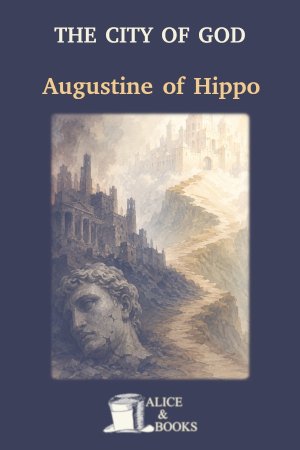
The City of God
The City of God is a philosophical and theological work written by Augustine of Hippo between 413 and 426 AD, following the sack of Rome by the Visigoths.
Augustine wrote the book in response to claims that Christianity had weakened the Roman Empire. He argues that Rome’s decline was not caused by the Christian faith and examines the moral and spiritual failures of pagan society.
The work contrasts two symbolic communities: the earthly city, shaped by self-interest and the pursuit of worldly power, and the City of God, founded on love of God and the hope of eternal life. These two cities coexist throughout human history but are guided by opposing values.
Combining history, philosophy, politics, and theology, The City of God presents a broad interpretation of human civilization and defends the belief that true peace and justice cannot be achieved through earthly empires alone.
"The glorious city of God is my theme in this work, which you, my dearest son Marcellinus,25 suggested, and which is due to you by my promise. I have undertaken its defence against those who prefer their own gods to the Founder of this city—a city surpassingly glorious, whether we view it as it still lives by faith in this fleeting course of time, and sojourns as a stranger in the midst of the ungodly, or as it shall dwell in the fixed stability of its eternal seat, which it now with patience waits for, expecting until “righteousness shall return unto judgment,”26 and it obtain, by virtue of its excellence, final victory and perfect peace."
This edition of The City of God was translated into English by Marcus Dods, George Wilson, and J. J. Smith.
Your download has started
PDF · The City of God — didn't start? Download again
Also available: PDF · EPUB · Read online
Read it on a Kindle
Download the EPUB and send it with Amazon's Send to Kindle (web, app, or your kindle.com email). Modern Kindles accept EPUB directly — no conversion needed.
On iPhone or iPad
Tap the downloaded file, then "Open in Books". It opens in Apple Books, with your reading progress synced across your devices.
On Android
Open the file with Google Play Books or any EPUB reader (ReadEra, Moon+ Reader). PDFs open in any viewer.
On your computer
PDFs open anywhere. For EPUB, try Calibre or Thorium Reader — both free and excellent.
Public domain (US)·No sign-up·DRM-free·Real text, not scans
Copyright note. The City of God by Saint Augustine of Hippo is believed to be in the public domain in the United States only. It may still be copyrighted in other countries. If you are not in the United States, please check your local laws to ensure this eBook is in the public domain in your country before downloading The City of God in PDF or EPUB.
- Pages
- 1232
- Reading time
- 38 hours 24 minutes
- Pace
- slow
- First published
- 426
- Language
- Late Latin
1600 years later, still timely
Why Read The City of God in 2026?
Written after the sack of Rome, Augustine's defense of Christianity grows into something larger: a theory of two cities — one built on power, one on love — running through all of history. It is philosophy, politics, and theology on a vast canvas.
Today's connection
When an order that felt permanent shakes, people ask what civilizations are for. Augustine's distinction between earthly power and deeper allegiance still frames debates about politics and faith.
Two cities
Power set against love.
History's arc
Civilization read whole.
Faith defended
An answer to Rome's critics.
Share this book
About the author

Saint Augustine of Hippo
Confession and philosophy joined; memory, will, and grace in living prose.