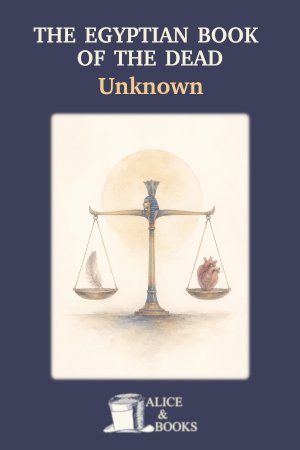
The Egyptian Book of the Dead
The Egyptian Book of the Dead is a collection of ancient Egyptian funerary texts composed and developed over many centuries. This edition was translated by British Egyptologist E. A. Wallis Budge and published under the title The Book of the Dead.
The work contains spells, prayers, hymns, and ritual instructions intended to guide the deceased through the dangers of the afterlife. These texts were often written on papyrus and placed in tombs to help the dead reach the realm of the gods and achieve eternal life.
Among its best-known passages is the description of the judgment of the dead, in which the heart of the deceased is weighed against the feather of truth and justice. The collection offers a vivid picture of Egyptian beliefs about death, morality, divine judgment, and immortality.
Rather than being a single book written by one author, The Egyptian Book of the Dead is a compilation of texts created by different scribes and religious traditions. Budge's influential translation helped introduce these ancient Egyptian religious beliefs to a broad English-speaking audience.
"Homage to thee, O Rā, when thou risest [as] Tem-Herukhuti (Tem-Harmachis). Thou art adored [by me when] thy beauties are before mine eyes, and [when thy] radiance [falleth] upon [my] body."
Your download has started
PDF · The Egyptian Book of the Dead — didn't start? Download again
Also available: PDF · EPUB · Read online
Read it on a Kindle
Download the EPUB and send it with Amazon's Send to Kindle (web, app, or your kindle.com email). Modern Kindles accept EPUB directly — no conversion needed.
On iPhone or iPad
Tap the downloaded file, then "Open in Books". It opens in Apple Books, with your reading progress synced across your devices.
On Android
Open the file with Google Play Books or any EPUB reader (ReadEra, Moon+ Reader). PDFs open in any viewer.
On your computer
PDFs open anywhere. For EPUB, try Calibre or Thorium Reader — both free and excellent.
Public domain (US)·No sign-up·DRM-free·Real text, not scans
Copyright note. The Egyptian Book of the Dead by Unknown is believed to be in the public domain in the United States only. It may still be copyrighted in other countries. If you are not in the United States, please check your local laws to ensure this eBook is in the public domain in your country before downloading The Egyptian Book of the Dead in PDF or EPUB.
- Reading time
- 3 hours 9 minutes
- Pace
- slow
- First published
- 1550
- Language
- Egyptian (Middle Egy
476 years later, still timely
Why Read The Egyptian Book of the Dead Today?
Spells, hymns, and declarations imagine a perilous passage beyond death. This funerary collection reveals how ancient Egyptians brought language, moral judgment, and divine assistance into the work of preparing for an afterlife.
Today's connection
Read as a window into a religious world, attending to ritual purpose as well as imagery. Translation and selection shape the collection in English.
Words for passage
Speech becomes ritual assistance.
Judgment and order
Moral life extends beyond death.
A collected tradition
Many texts serve related purposes.
Share this book
About the author
Unknown
Anonymous voices that carry myth, prayer, and technique across centuries without preserved names.