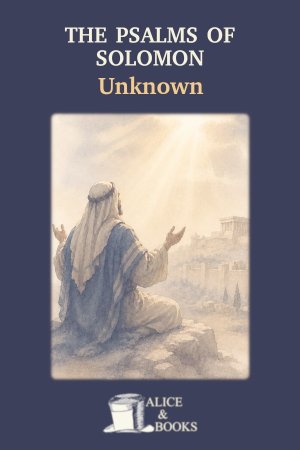
The Psalms of Solomon
The Psalms of Solomon is a collection of eighteen Jewish religious poems written by an unknown author or authors, probably in the first century BC. This English version was translated by Rutherford H. Platt, Jr. and included in The Forgotten Books of Eden (1928).
The psalms reflect a period of political turmoil, religious conflict, and foreign domination. They combine prayers, laments, and expressions of hope, while condemning injustice and calling for faithfulness to God.
A recurring theme is the expectation of divine judgment and the restoration of Israel. Several passages look forward to a righteous ruler who will defeat the wicked, purify Jerusalem, and establish justice, ideas that later became important in discussions of Jewish messianic thought.
The Psalms of Solomon offers valuable insight into Jewish religious beliefs and hopes during the late Second Temple period, especially ideas concerning righteousness, repentance, judgment, and the coming of a divinely appointed king.
"1. I cried unto the Lord when I was in distress,
Unto God when sinners assailed.
2. Suddenly the alarm of war was heard before me;
I said, He will hearken to me for I am full of righteousness."
Your download has started
PDF · The Psalms of Solomon — didn't start? Download again
Also available: PDF · EPUB · Read online
Read it on a Kindle
Download the EPUB and send it with Amazon's Send to Kindle (web, app, or your kindle.com email). Modern Kindles accept EPUB directly — no conversion needed.
On iPhone or iPad
Tap the downloaded file, then "Open in Books". It opens in Apple Books, with your reading progress synced across your devices.
On Android
Open the file with Google Play Books or any EPUB reader (ReadEra, Moon+ Reader). PDFs open in any viewer.
On your computer
PDFs open anywhere. For EPUB, try Calibre or Thorium Reader — both free and excellent.
Public domain (US)·No sign-up·DRM-free·Real text, not scans
Copyright note. The Psalms of Solomon by Unknown is believed to be in the public domain in the United States only. It may still be copyrighted in other countries. If you are not in the United States, please check your local laws to ensure this eBook is in the public domain in your country before downloading The Psalms of Solomon in PDF or EPUB.
- Reading time
- 34 minutes
- Pace
- slow
- First published
- 1626
- Language
- Koine Greek (origina
400 years later, still timely
Why Read The Psalms of Solomon Today?
These ancient Jewish psalms join lament, moral accusation, and hope for restoration. Political disorder becomes a religious question, with justice imagined beyond the failures of rulers and institutions.
Today's connection
A compact entry into the language of collective grievance and hope. Read the speakers' judgments alongside their expectations of what a just community should become.
Communal lament
Public suffering enters prayer.
Moral reckoning
Power is measured against justice.
Hope for restoration
Expectation gives lament a direction.
Share this book
About the author
Unknown
Anonymous voices that carry myth, prayer, and technique across centuries without preserved names.