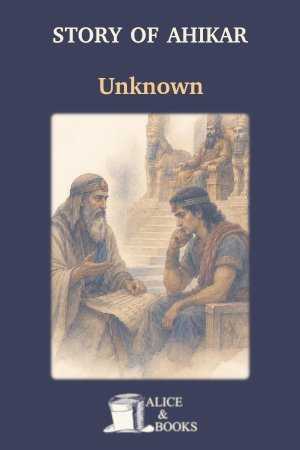
The Story of Ahikar
The Story of Ahikar is an ancient Near Eastern wisdom tale whose origins date back many centuries before the Christian era. This English version was translated by Rutherford H. Platt, Jr. and included in The Forgotten Books of Eden (1928).
The story follows Ahikar, a wise and respected counselor to the king of Assyria, who adopts his nephew Nadan and attempts to teach him wisdom, good conduct, and loyalty. Despite Ahikar's guidance, Nadan betrays him and falsely accuses him of treason.
Ahikar is sentenced to death, but through the loyalty of a friend he secretly survives. When the kingdom later faces a difficult challenge, Ahikar's wisdom proves indispensable, allowing him to return to favor and expose his nephew's deception.
Blending narrative with a large collection of proverbs and moral teachings, The Story of Ahikar explores wisdom, betrayal, justice, gratitude, and the consequences of foolish behavior. The work became influential across several ancient literary and religious traditions.
"Ahikar, Grand Vizier of Assyria, has 60 wives but is fated to have no son. Therefore he adopts his nephew. He crams him full of wisdom and knowledge more than of bread and water."
Your download has started
PDF · The Story of Ahikar — didn't start? Download again
Also available: PDF · EPUB · Read online
Read it on a Kindle
Download the EPUB and send it with Amazon's Send to Kindle (web, app, or your kindle.com email). Modern Kindles accept EPUB directly — no conversion needed.
On iPhone or iPad
Tap the downloaded file, then "Open in Books". It opens in Apple Books, with your reading progress synced across your devices.
On Android
Open the file with Google Play Books or any EPUB reader (ReadEra, Moon+ Reader). PDFs open in any viewer.
On your computer
PDFs open anywhere. For EPUB, try Calibre or Thorium Reader — both free and excellent.
Public domain (US)·No sign-up·DRM-free·Real text, not scans
Copyright note. The Story of Ahikar by Unknown is believed to be in the public domain in the United States only. It may still be copyrighted in other countries. If you are not in the United States, please check your local laws to ensure this eBook is in the public domain in your country before downloading The Story of Ahikar in PDF or EPUB.
- Reading time
- 1 hour 5 minutes
- Pace
- intermediate
- First published
- 500
- Language
- Aramaic (original; a
1526 years later, still timely
Why Read The Story of Ahikar Today?
A wise counselor trains an heir who turns against him. Court intrigue frames Ahikar's sayings, giving advice about loyalty, speech, and prudence a narrative in which it can be tested.
Today's connection
An engaging comparison with modern advice writing: maxims sound secure on their own, but the surrounding story asks how wisdom survives betrayal and unequal power.
Wisdom within a story
Sayings face practical consequences.
Courtly danger
Favor can turn into accusation.
Speech and restraint
Advice concerns when and how to speak.
Share this book
About the author
Unknown
Anonymous voices that carry myth, prayer, and technique across centuries without preserved names.