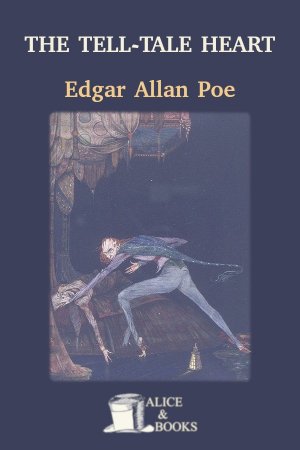
The Tell-Tale Heart
The Tell-Tale Heart is a short story written by Edgar Allan Poe, first published in the literary journal The Pioneer in 1843.
The unnamed narrator insists on being sane while claiming unusually acute senses. Despite professing affection for the old man with whom he lives, he becomes obsessed with one of the man’s pale blue eyes, which he calls a “vulture eye.” Their relationship is left unexplained.
The obsession leads the narrator to watch the old man night after night before killing and dismembering him. He conceals the remains beneath the floorboards.
After a neighbor reports hearing a shriek, three police officers search the house. Confident that the crime is hidden, the narrator invites them to sit directly above the body, but then hears what seems to be a heart beating beneath the floor. Whether the sound is real or imagined, its growing intensity drives him to confess and reveal the remains.
This digital edition of The Tell-Tale Heart is based on the transcription first published in The Pioneer in January 1843 by Wikisource.
Your download has started
PDF · The Tell-Tale Heart — didn't start? Download again
Also available: PDF · EPUB · MOBI · Read online
Read it on a Kindle
Download the EPUB and send it with Amazon's Send to Kindle (web, app, or your kindle.com email). Modern Kindles accept EPUB directly — no conversion needed.
On iPhone or iPad
Tap the downloaded file, then "Open in Books". It opens in Apple Books, with your reading progress synced across your devices.
On Android
Open the file with Google Play Books or any EPUB reader (ReadEra, Moon+ Reader). PDFs open in any viewer.
On your computer
PDFs open anywhere. For EPUB, try Calibre or Thorium Reader — both free and excellent.
Public domain (US)·No sign-up·DRM-free·Real text, not scans
Copyright note. The Tell-Tale Heart by Edgar Allan Poe is believed to be in the public domain in the United States only. It may still be copyrighted in other countries. If you are not in the United States, please check your local laws to ensure this eBook is in the public domain in your country before downloading The Tell-Tale Heart in PDF or EPUB.
- Pages
- 8
- Reading time
- 11 minutes
- Pace
- Fast
- First published
- 1843
- Language
- English
- Downloads
- 7,629
183 years later, still timely
Why Read The Tell-Tale Heart in 2026?
Night, a heartbeat, and a mind arguing with itself. “The Tell-Tale Heart” is a two-page sprint through guilt and noise—perfect for teaching point of view, pacing, and how obsession makes its own soundtrack.
Today's connection
Use it to show students how syntax speeds fear, how sound motifs unify a story, and how unreliable narration invites readers to judge. Read aloud; let the rhythm do the work. It’s a miniature you can revisit and still find new craft choices.
Sound as plot
Heartbeat and hush drive action and remorse.
Unreliable lens
What he insists on reveals what he hides.
Compression
Every word works; nothing spares you.
These collections include The Tell-Tale Heart


Share this book
About the author

Edgar Allan Poe
Precision of mood and method that invents detective logic and the claustrophobia of obsession.
If this one stays with you…

DraculaBram Stoker

The Legend of Sleepy HollowWashington Irving

FrankensteinMary Shelley

The King in YellowRobert W. Chambers
From The Tell-Tale Heart
And have I not told you that what you mistake for madness is but over-acuteness of the sense.
It is impossible to say how first the idea entered my brain; but once conceived, it haunted me day and night.
Almighty God!—no, no! They heard!—they suspected!—they knew!—they were making a mockery of my horror!—this I thought, and this I think.
True, nervous, very, very dreadfully nervous I had been and am, but why will say that I am mad?! The disease had sharpened my senses, not destroyed, not dulled them. Above all was the sense of hearing acute.
And this I did for seven long nights—every night just at midnight—but I found the eye always closed; and so it was impossible to do the work; for it was not the old man who vexed me, but his Evil Eye.