The Coffee-House of Surat
The Coffee-House of Surat is a short philosophical tale by Leo Tolstoy, first published in 1893.
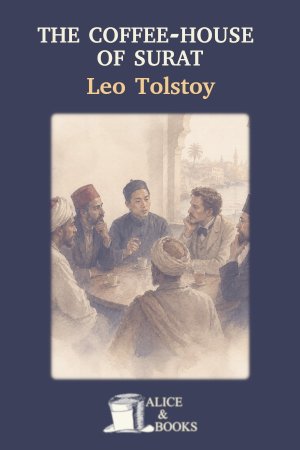
The story is set in a coffee-house in Surat, India, where travelers from different countries and religious traditions gather and begin arguing about the nature of God and which faith possesses the truth. Each man defends his own beliefs and dismisses those of the others, turning their discussion into a reflection on religious intolerance and human pride.
A Chinese student who has been listening quietly responds by telling a parable about people who disagree over the existence and nature of the sun. Through his story, Tolstoy suggests that human beings often mistake their limited understanding for absolute truth and that no single perspective can fully contain what is universal.
"In the town of Surat, in India, was a coffee-house where many travellers and foreigners from all parts of the world met and conversed.
One day a learned Persian theologian visited this coffee-house. He was a man who had spent his life studying the nature of the Deity, and reading and writing books upon the subject. "
This text is based on the English translation by Louise and Aylmer Maude from the edition What Men Live By, and Other Tales, available through Project Gutenberg.
Your download has started
PDF · The Coffee-House of Surat — didn't start? Download again
Also available: PDF · EPUB · Read online
Read it on a Kindle
Download the EPUB and send it with Amazon's Send to Kindle (web, app, or your kindle.com email). Modern Kindles accept EPUB directly — no conversion needed.
On iPhone or iPad
Tap the downloaded file, then "Open in Books". It opens in Apple Books, with your reading progress synced across your devices.
On Android
Open the file with Google Play Books or any EPUB reader (ReadEra, Moon+ Reader). PDFs open in any viewer.
On your computer
PDFs open anywhere. For EPUB, try Calibre or Thorium Reader — both free and excellent.
Public domain (US)·No sign-up·DRM-free·Real text, not scans
Copyright note. The Coffee-House of Surat by Leo Tolstoy is believed to be in the public domain in the United States only. It may still be copyrighted in other countries. If you are not in the United States, please check your local laws to ensure this eBook is in the public domain in your country before downloading The Coffee-House of Surat in PDF or EPUB.
- Pages
- 11
- Reading time
- 14 minutes
- Pace
- intermediate
- First published
- 1893
- Language
- Russian
133 years later, still timely
Why Read The Coffee-House of Surat Today?
Travelers argue over whose faith contains the truth until a parable changes the terms. Tolstoy gives religious certainty a small public stage and lets competing perspectives expose its limits.
Today's connection
Useful for discussing disagreement without treating conviction as proof. The story asks how much of any confident judgment comes from a limited vantage point.
Many convictions
A meeting place becomes a debate.
Parable within a tale
An image reframes the argument.
Intellectual humility
Partial sight can feel complete.
Share this book
About the author

Leo Tolstoy
Epic realism with intimate ethics; the cadence of daily life turned into vision and care.