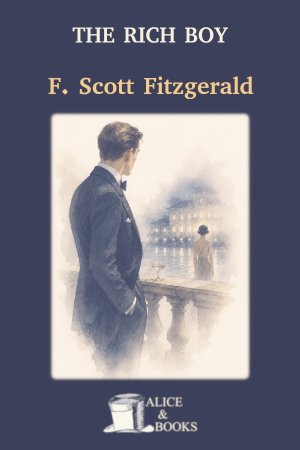
The Rich Boy
The Rich Boy is a short story by F. Scott Fitzgerald, first published in 1926. Set among the wealthy circles of early twentieth-century America, it examines privilege, love, emotional isolation, and the influence of money on personal relationships.
The story centers on a young man born into great wealth whose privileged upbringing shapes the way he sees himself and others. Although charming and socially successful, he finds it difficult to form lasting emotional connections and struggles when his romantic life does not unfold as he expects.
His relationship with a woman he deeply loves becomes the central conflict of the story. Pride, misunderstanding, and differences in temperament gradually separate them, revealing the limits of wealth and social status when confronted with genuine emotional needs.
Through its reflective narration, Fitzgerald presents a critical portrait of the American upper class and explores how privilege can create distance, entitlement, and loneliness. The story anticipates many of the themes that appear throughout Fitzgerald's fiction, particularly the contrast between material success and personal fulfillment.
"Begin with an individual, and before you know it you find that you have created a type; begin with a type, and you find that you have created—nothing. That is because we are all queer fish, queerer behind our faces and voices than we want any one to know or than we know ourselves. "
Your download has started
PDF · The Rich Boy — didn't start? Download again
Also available: PDF · EPUB · Read online
Read it on a Kindle
Download the EPUB and send it with Amazon's Send to Kindle (web, app, or your kindle.com email). Modern Kindles accept EPUB directly — no conversion needed.
On iPhone or iPad
Tap the downloaded file, then "Open in Books". It opens in Apple Books, with your reading progress synced across your devices.
On Android
Open the file with Google Play Books or any EPUB reader (ReadEra, Moon+ Reader). PDFs open in any viewer.
On your computer
PDFs open anywhere. For EPUB, try Calibre or Thorium Reader — both free and excellent.
Public domain (US)·No sign-up·DRM-free·Real text, not scans
Copyright note. The Rich Boy by F. Scott Fitzgerald is believed to be in the public domain in the United States only. It may still be copyrighted in other countries. If you are not in the United States, please check your local laws to ensure this eBook is in the public domain in your country before downloading The Rich Boy in PDF or EPUB.
- Pages
- 43
- Reading time
- 1 hour 11 minutes
- Pace
- intermediate
- First published
- 1926
- Language
- English
100 years later, still timely
Why Read The Rich Boy Today?
Anson Hunter's wealth shapes his expectations so deeply that he barely sees them as expectations. Fitzgerald follows the distance between social ease and the ability to sustain an intimate relationship.
Today's connection
A revealing study of privilege as a habit of mind. Money changes not only available choices but also what a person assumes others will forgive.
Inherited assurance
Comfort becomes a way of seeing.
Emotional distance
Ease in society is not intimacy.
An observing voice
Character emerges through a friend's account.
Share this book
About the author

F. Scott Fitzgerald
Jazz Age style that tests desire, class, and the dream of reinvention.