Three Questions
Three Questions is a short story written by Leo Tolstoy and first published in 1903.
The story follows a king who believes he will never fail if he can discover the answers to three important questions: What is the right time to begin something? Who are the most important people to listen to? And what is the most important thing to do?
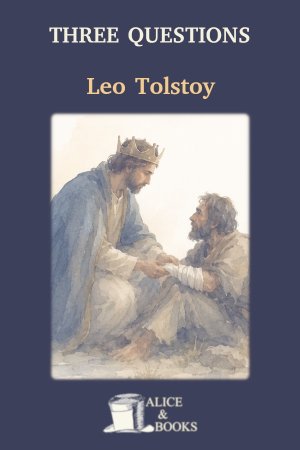
After receiving many different answers from learned men, the king visits a wise hermit. Through a series of unexpected events, including helping the hermit and caring for a wounded stranger, he gradually learns the answers through his own actions rather than through abstract advice.
Tolstoy's story teaches that the most important time is the present moment, the most important person is the one you are with, and the most important task is to do good for others. It is a simple moral tale about compassion, attention, and living meaningfully in the present.
"It once occurred to a certain king, that if he always knew the right time to begin everything; if he knew who were the right people to listen to, and whom to avoid; and, above all, if he always knew what was the most important thing to do, he would never fail in anything he might undertake."
The English translation was made by Louise and Aylmer Maude, two of the best-known translators of Tolstoy's works into English.
Your download has started
PDF · Three Questions — didn't start? Download again
Also available: PDF · EPUB · Read online
Read it on a Kindle
Download the EPUB and send it with Amazon's Send to Kindle (web, app, or your kindle.com email). Modern Kindles accept EPUB directly — no conversion needed.
On iPhone or iPad
Tap the downloaded file, then "Open in Books". It opens in Apple Books, with your reading progress synced across your devices.
On Android
Open the file with Google Play Books or any EPUB reader (ReadEra, Moon+ Reader). PDFs open in any viewer.
On your computer
PDFs open anywhere. For EPUB, try Calibre or Thorium Reader — both free and excellent.
Public domain (US)·No sign-up·DRM-free·Real text, not scans
Copyright note. Three Questions by Leo Tolstoy is believed to be in the public domain in the United States only. It may still be copyrighted in other countries. If you are not in the United States, please check your local laws to ensure this eBook is in the public domain in your country before downloading Three Questions in PDF or EPUB.
- Pages
- 8
- Reading time
- 8 minutes
- Pace
- slow
- First published
- 1903
- Language
- Russian
123 years later, still timely
Why Read Three Questions Today?
A king seeks three answers that will make his decisions infallible. Tolstoy sends him to a hermit, where ordinary tasks interrupt the search and turn attention into the real subject.
Today's connection
A brief prompt for discussing care and priorities. Its scale is deliberately small: the next useful act matters more than an abstract plan for perfect judgment.
Questions made concrete
An argument becomes an encounter.
Present attention
Immediate needs interrupt grand plans.
Ethics through action
Help arrives before an explanation.
Share this book
About the author

Leo Tolstoy
Epic realism with intimate ethics; the cadence of daily life turned into vision and care.