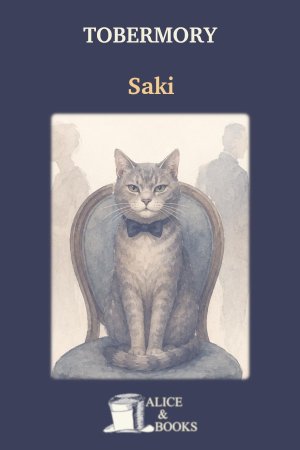
Tobermory
Tobermory is a short story written by Saki (H. H. Munro) and first published in 1909.
The story takes place at a country-house gathering where a guest announces that he has succeeded in teaching a cat to speak like a human being. The cat, Tobermory, soon astonishes everyone by answering questions with perfect clarity.
The guests' excitement quickly turns to panic when Tobermory begins revealing private conversations, secrets, and unflattering opinions he has overheard around the house. Fearing further embarrassment, the group decides that the dangerously truthful cat must be silenced.
With its sharp dialogue and absurd premise, the story satirizes hypocrisy, social pretension, and the fear of uncomfortable truths, turning a seemingly amusing experiment into a darkly comic disaster.
"IT was a chill, rain-washed afternoon of a late August day, that indefinite season when partridges are still in security or cold storage, and there is nothing to hunt—unless one is bounded on the north by the Bristol Channel, in which case one may lawfully gallop after fat red stags. Lady Blemley's house-party was not bounded on the north by the Bristol Channel, hence there was a full gathering of her guests round the tea-table on this particular afternoon."
Your download has started
PDF · Tobermory — didn't start? Download again
Also available: PDF · EPUB · Read online
Read it on a Kindle
Download the EPUB and send it with Amazon's Send to Kindle (web, app, or your kindle.com email). Modern Kindles accept EPUB directly — no conversion needed.
On iPhone or iPad
Tap the downloaded file, then "Open in Books". It opens in Apple Books, with your reading progress synced across your devices.
On Android
Open the file with Google Play Books or any EPUB reader (ReadEra, Moon+ Reader). PDFs open in any viewer.
On your computer
PDFs open anywhere. For EPUB, try Calibre or Thorium Reader — both free and excellent.
Public domain (US)·No sign-up·DRM-free·Real text, not scans
Copyright note. Tobermory by Saki is believed to be in the public domain in the United States only. It may still be copyrighted in other countries. If you are not in the United States, please check your local laws to ensure this eBook is in the public domain in your country before downloading Tobermory in PDF or EPUB.
- Pages
- 11
- Reading time
- 14 minutes
- Pace
- fast
- First published
- 1909
- Language
- English
117 years later, still timely
Why Read Tobermory Today?
A country-house cat learns to speak and immediately becomes a social emergency. Saki finds the perfect witness to polite hypocrisy: an animal nobody thought to exclude from private conversations.
Today's connection
A comic companion to discussions of privacy and reputation. The guests welcome a technological marvel until it repeats what they actually said.
An inconvenient witness
The household pet has heard everything.
Drawing-room panic
Politeness gives way to self-preservation.
Satirical dialogue
Every response exposes another weakness.
Share this book
About the author

Saki
Edwardian drawing rooms sabotaged by wit; short stories that end like traps.