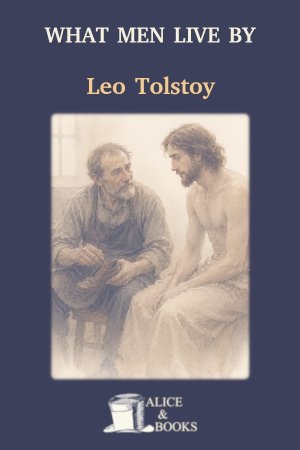
What Men Live By
What Men Live By is a short story by Leo Tolstoy, first published in 1885.
The story follows a poor shoemaker who encounters a mysterious naked man suffering from the cold and decides to take him home despite his own poverty. The stranger, Michael, begins working with the shoemaker and gradually reveals that he has been sent to earth to learn three essential truths about human life.
Through a series of encounters with customers and strangers, Michael comes to understand what dwells in man, what is not given to man to know, and what men truly live by. Tolstoy uses the tale to emphasize compassion, humility, and the idea that human beings ultimately live through love rather than through self-interest or material security.
"A shoemaker named Simon, who had neither house nor land of his own, lived with his wife and children in a peasant’s hut, and earned his living by his work. Work was cheap, but bread was dear, and what he earned he spent for food. The man and his wife had but one sheepskin coat between them for winter wear, and even that was torn to tatters, and this was the second year he had been wanting to buy sheep-skins for a new coat."
This text is based on the English translation by Louise and Aylmer Maude from the edition What Men Live By, and Other Tales, available through Project Gutenberg.
Your download has started
PDF · What Men Live By — didn't start? Download again
Also available: PDF · EPUB · Read online
Read it on a Kindle
Download the EPUB and send it with Amazon's Send to Kindle (web, app, or your kindle.com email). Modern Kindles accept EPUB directly — no conversion needed.
On iPhone or iPad
Tap the downloaded file, then "Open in Books". It opens in Apple Books, with your reading progress synced across your devices.
On Android
Open the file with Google Play Books or any EPUB reader (ReadEra, Moon+ Reader). PDFs open in any viewer.
On your computer
PDFs open anywhere. For EPUB, try Calibre or Thorium Reader — both free and excellent.
Public domain (US)·No sign-up·DRM-free·Real text, not scans
Copyright note. What Men Live By by Leo Tolstoy is believed to be in the public domain in the United States only. It may still be copyrighted in other countries. If you are not in the United States, please check your local laws to ensure this eBook is in the public domain in your country before downloading What Men Live By in PDF or EPUB.
- Pages
- 28
- Reading time
- 40 minutes
- Pace
- intermediate
- First published
- 1881
- Language
- Russian
145 years later, still timely
Why Read What Men Live By in 2026?
A poor shoemaker takes in a freezing stranger, and the stranger turns out to be learning what human beings truly live by. Tolstoy writes it as a folk parable—plain sentences, village life, and questions that cut straight to the bone.
Today's connection
In a culture obsessed with security and self-interest, this tale makes a quiet counterargument: that lives run on love and mutual care. It rewards slow, reflective reading.
Radical charity
Kindness despite scarcity
Three truths
A parable with a lesson
Folk parable
Plain style, deep questions
Share this book
About the author

Leo Tolstoy
Epic realism with intimate ethics; the cadence of daily life turned into vision and care.