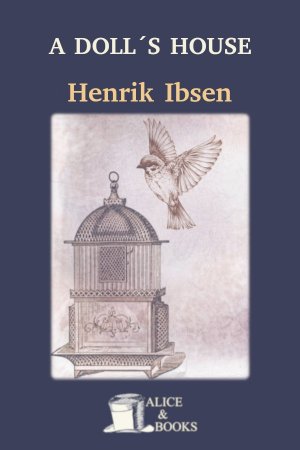
A Doll's House
A Doll's House is a play written by Henrik Ibsen first published and performed in 1879. The main theme is about the destiny of a married woman and how her life collapses, in a society in which she has no opportunities to fulfill herself after being dominated by men.
We are located in a town in Norway around the year 1879. Nora Helmer is happily married to Torvald Helmer, a lawyer who has just been appointed manager of the bank, and they have three children. What Torvald does not know is that Nora once forged her dying father's signature to borrow the money that paid for the journey south that saved Torvald's life.
Nils Krogstad, the bank employee who lent her that money, is about to lose his post — he committed a forgery of his own years ago. He blackmails Nora with the promissory note to keep his job, but Torvald will not give in.
Kristine Linde, an old friend of Nora's and the woman Krogstad once loved, takes the post at the bank instead, and Krogstad carries out his threat. The letter he leaves brings the whole arrangement into the open.
The title refers to the house in which Nora has been kept as a doll — petted, indulged, and never taken seriously — and to the decision she reaches in the last act.
Your download has started
PDF · A Doll's House — didn't start? Download again
Also available: PDF · EPUB · MOBI · Read online
Read it on a Kindle
Download the EPUB and send it with Amazon's Send to Kindle (web, app, or your kindle.com email). Modern Kindles accept EPUB directly — no conversion needed.
On iPhone or iPad
Tap the downloaded file, then "Open in Books". It opens in Apple Books, with your reading progress synced across your devices.
On Android
Open the file with Google Play Books or any EPUB reader (ReadEra, Moon+ Reader). PDFs open in any viewer.
On your computer
PDFs open anywhere. For EPUB, try Calibre or Thorium Reader — both free and excellent.
Public domain (US)·No sign-up·DRM-free·Real text, not scans
Copyright note. A Doll's House by Henrik Ibsen is believed to be in the public domain in the United States only. It may still be copyrighted in other countries. If you are not in the United States, please check your local laws to ensure this eBook is in the public domain in your country before downloading A Doll's House in PDF or EPUB.
- Pages
- 112
- Reading time
- 2 hours 13 minutes
- Pace
- Intermediate
- First published
- 1879
- Language
- Norwegian
- Downloads
- 7,827
147 years later, still timely
Why Read A Doll's House in 2026?
A play that begins politely and ends with a door that still echoes. Ibsen builds a domestic argument into a case for dignity, agency, and honest love.
Today's connection
Money, marriage, and masks—this script turns household details into ethical stakes. Read it aloud or see it staged; the conversations feel uncomfortably current and productively clarifying.
Respect as baseline
Affection without equality is fragile.
Talk that reveals
Persuasion, evasion, and finally truth.
Papers with power
Contracts and signatures steer lives.
Share this book
About the author

Henrik Ibsen
Modern drama about truth telling, roles, and the cost of freedom at home and in public.