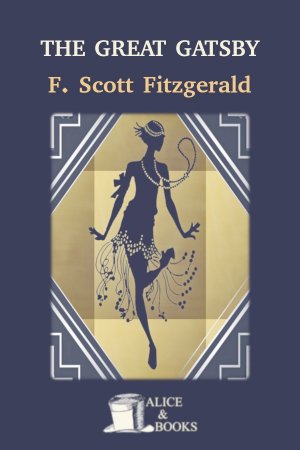
The Great Gatsby
The Great Gatsby is a novel written by F. Scott Fitzgerald and published in 1925. It is widely considered the author’s masterpiece and a central novel of American modernism.
Set on Long Island and in New York City in 1922, the novel follows the mysterious millionaire Jay Gatsby and his attempt to recover a past he associates with Daisy Buchanan. His lavish parties mask loneliness and a carefully constructed identity, while the wealth around him exposes the excess and moral carelessness of the Jazz Age.
The book opens with Nick Carraway, a Midwestern native and World War I veteran who moves to New York for work and rents a house on Long Island, next door to Jay Gatsby's grand mansion. Nick, Daisy’s cousin, narrates the story from his own limited and increasingly disillusioned perspective.
The novel deals with themes such as decadence, idealism, and social upheaval, reflecting the tensions within American society of the Roaring Twenties. The book's initial sales were disappointing, and its reviews were mixed. After the author’s death and World War II, however, the novel’s reputation grew substantially.
It became widely taught and has been adapted for stage and screen. In 1998, the Modern Library board ranked it second on its list of the 100 best English-language novels of the 20th century.
Your download has started
PDF · The Great Gatsby — didn't start? Download again
Also available: PDF · EPUB · MOBI · Read online
Read it on a Kindle
Download the EPUB and send it with Amazon's Send to Kindle (web, app, or your kindle.com email). Modern Kindles accept EPUB directly — no conversion needed.
On iPhone or iPad
Tap the downloaded file, then "Open in Books". It opens in Apple Books, with your reading progress synced across your devices.
On Android
Open the file with Google Play Books or any EPUB reader (ReadEra, Moon+ Reader). PDFs open in any viewer.
On your computer
PDFs open anywhere. For EPUB, try Calibre or Thorium Reader — both free and excellent.
Public domain (US)·No sign-up·DRM-free·Real text, not scans
Copyright note. The Great Gatsby by F. Scott Fitzgerald is believed to be in the public domain in the United States only. It may still be copyrighted in other countries. If you are not in the United States, please check your local laws to ensure this eBook is in the public domain in your country before downloading The Great Gatsby in PDF or EPUB.
- Pages
- 140
- Reading time
- 4 hours 6 minutes
- Pace
- Intermediate
- First published
- 1925
- Language
- English
- Downloads
- 10,595
101 years later, still timely
Why Read The Great Gatsby in 2026?
A slim novel with a long aftertaste. "The Great Gatsby" pairs glittering sentences with forensic attention to money, image, and longing. Parties look like camouflage; silences do the talking. It’s quick to read and slow to shake, especially if you’ve ever mistaken display for desire.
Today's connection
Status performance, housing, and curated identity still organize desire. The narrator’s distance teaches how point of view shapes judgment. Read it for line-by-line craft as much as for plot. The book grows wiser each time you notice who is looking and from where.
Style as X-ray
Metaphor, cadence, and restraint reveal motive. Beauty does analytical work.
Narrator and distance
Observation is partial by design. The angle matters as much as the scene.
Status on stage
Rooms, cars, and clothes perform class. Surfaces argue about value.
These collections include The Great Gatsby
Movies based on books
Every book here names the film it became, and links to it. Read the book before, or after, the version you have seen.
Explore the collection →
Indispensable High School Reads
Four years of assigned reading, sorted by how long each book will take you — and a straight answer about the ones you will have to borrow.
Explore the collection →Classic Romance Novels Worth Reading
Love tested by money, class and time — including the six Austen novels and all seven the Brontë sisters wrote.
Explore the collection →


The Modern Library: 100 Best Novels
The 1998 list, in its own order — and which of the hundred we can legally give you.
Explore the collection →
9th Grade Reading List
Freshman English, with the page count and the reading time on every book — and a straight answer about the ones you will have to borrow.
Explore the collection →Share this book
About the author

F. Scott Fitzgerald
Jazz Age style that tests desire, class, and the dream of reinvention.
If this one stays with you…
Sense and SensibilityJane Austen
Pride and PrejudiceJane Austen
EmmaJane Austen
Agnes GreyAnne Brontë
From The Great Gatsby
I hope she'll be a fool. That’s the best thing a girl can be in this world, a beautiful little fool.
Dishonesty in a woman is a thing you never blame deeply.
Her voice is full of money.
And I like large parties. They’re so intimate. At small parties there isn’t any privacy.
No amount of fire or freshness can challenge what a man will store up in his ghostly heart.