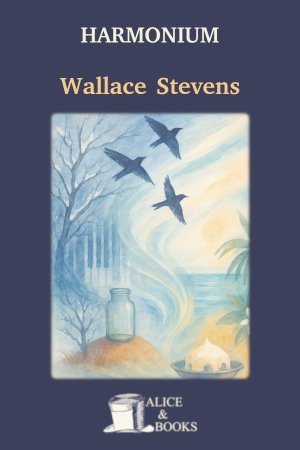
Harmonium
Harmonium is the debut poetry collection of Wallace Stevens, first published in 1923.
A touchstone of American modernism, it showcases his dazzling ear and visual flair while staking out a poetics that balances thought and sensation.
Throughout these poems, Stevens investigates the tension between imagination and reality, using lush images, surprising metaphors, and playful argument to test how the mind composes the world. His lines move with music-like language and a wry philosophical streak that turns everyday scenes into occasions for insight.
Signature pieces such as “Sunday Morning,” “Thirteen Ways of Looking at a Blackbird,” and “The Emperor of Ice-Cream” exemplify the book’s range: meditations on belief and secular beauty, experiments in shifting perspectives, and declarations of earthy, transient life over abstraction. The collection’s variety keeps its tone agile, from luxuriant reverie to crisp, crystalline clarity.
Compact yet inexhaustible, Harmonium endures as a landmark of 20th-century American poetry. It invites readers to return again and again, discovering new harmonies between sensory delight and intellectual play in every reread.
"You dweller in the dark cabin,
To whom the watermelon is always purple,
Whose garden is wind and moon,
Of the two dreams, night and day,
What lover, what dreamer, would choose
The one obscured by sleep?"
Your download has started
PDF · Harmonium — didn't start? Download again
Also available: PDF · EPUB · Read online
Read it on a Kindle
Download the EPUB and send it with Amazon's Send to Kindle (web, app, or your kindle.com email). Modern Kindles accept EPUB directly — no conversion needed.
On iPhone or iPad
Tap the downloaded file, then "Open in Books". It opens in Apple Books, with your reading progress synced across your devices.
On Android
Open the file with Google Play Books or any EPUB reader (ReadEra, Moon+ Reader). PDFs open in any viewer.
On your computer
PDFs open anywhere. For EPUB, try Calibre or Thorium Reader — both free and excellent.
Public domain (US)·No sign-up·DRM-free·Real text, not scans
Copyright note. Harmonium by Wallace Stevens is believed to be in the public domain in the United States only. It may still be copyrighted in other countries. If you are not in the United States, please check your local laws to ensure this eBook is in the public domain in your country before downloading Harmonium in PDF or EPUB.
- Pages
- 93
- Reading time
- 1 hour 4 minutes
- Pace
- Varies
- First published
- 1923
- Language
- English
103 years later, still timely
Why Read Harmonium in 2026?
Modernist poetry that actually feels alive on the tongue. 'Harmonium' blends color, weather, and wit into lines that reward being read aloud; imagination does not flee reality—it recasts it. Stevens is playful and exact, and the poems teach you how to notice. Five pages can reset a day.
Today's connection
Attention has texture. These poems practice it: sound first, then thought, then surprise. Keep a pencil; the images snap into focus on the second pass. Ideal for workshops and anyone rebuilding a reading habit.
Sound before paraphrase
Alliteration, stress, and pause carry sense. Meaning arrives by ear.
Color and image
Citrons, snow, and jars—objects stage ideas. Visual precision prevents vagueness.
Imagination as method
Not escape, a tool. The poems test how mind remakes the world.
Share this book
About the author

Wallace Stevens
Philosophical lyric where imagination meets the real; crisp images and thinking music.