
The Devils
The Devils, also known as Demons, is a novel by Fyodor Dostoevsky, serialized in 1871–72 and published in book form in 1872. This social and political satire is considered one of Dostoevsky's masterpieces.
The book is a social critique of the consequences of the growing political and moral nihilism in Russia in the 1860s. The setting is a provincial Russian town that descends into chaos as a conspiratorial revolutionary cell organized by Pyotr Verkhovensky turns to manipulation and violence.
The narrator, Anton Lavrentyevich, is a minor local official and an associate of Pyotr’s father, Stepan Trofimovich Verkhovensky. He chronicles the events surrounding Pyotr’s conspiracy and the enigmatic Nikolai Stavrogin, combining what he witnesses with information gathered from others.
Constance Garnett's translation has been used for this digital edition of the book The Devils.
Your download has started
PDF · The Devils — didn't start? Download again
Also available: PDF · EPUB · MOBI · Read online
Read it on a Kindle
Download the EPUB and send it with Amazon's Send to Kindle (web, app, or your kindle.com email). Modern Kindles accept EPUB directly — no conversion needed.
On iPhone or iPad
Tap the downloaded file, then "Open in Books". It opens in Apple Books, with your reading progress synced across your devices.
On Android
Open the file with Google Play Books or any EPUB reader (ReadEra, Moon+ Reader). PDFs open in any viewer.
On your computer
PDFs open anywhere. For EPUB, try Calibre or Thorium Reader — both free and excellent.
Public domain (US)·No sign-up·DRM-free·Real text, not scans
Copyright note. The Devils by Fyodor Dostoevsky is believed to be in the public domain in the United States only. It may still be copyrighted in other countries. If you are not in the United States, please check your local laws to ensure this eBook is in the public domain in your country before downloading The Devils in PDF or EPUB.
- Pages
- 673
- Reading time
- 21 hours 19 minutes
- Pace
- Intermediate
- First published
- 1872
- Language
- Russian
- Downloads
- 10,160
154 years later, still timely
Why Read The Devils in 2026?
A provincial circle plays with ideas like fire and burns the house down—politics, faith, vanity, and grief in terrifying motion. Dostoevsky builds a case against nihilism without strawmen.
Today's connection
The novel watches rumor, ambition, and performance turn talk into violence. Its portraits of manipulation, loneliness, and spectacle feel uncomfortably current. Read it to study how ideology recruits, how groups harden, and how ordinary decency resists. Long, yes—but the social scenes and public set pieces move. It’s a difficult, clarifying mirror for times when argument drifts toward cruelty.
Rhetoric under the skin
Speeches, salons, and pamphlets show how ideas recruit.
Cells and crowds
Friendships sour into factions; pressure multiplies.
Consequences escalate
Small provocations compound into tragedy—plotted, not random.
Share this book
About the author
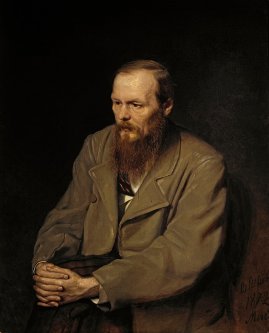
Fyodor Dostoevsky
Psychological depth and moral crisis under pressure; fiction that tests conscience, freedom, and society.
If this one stays with you…

The Voyage OutVirginia Woolf

Jacob's RoomVirginia Woolf

UlyssesJames Joyce

Pierre et JeanGuy de Maupassant
From The Devils
It must be true that the whole second half of a man's life is most often made up only of habits accumulated during the first half.
God is the pain of the fear of death.
If you want to overcome the whole world, overcome yourself.
My friend, the truth is always implausible, did you know that? To make the truth more plausible, it's absolutely necessary to mix a bit of falsehood with it. People have always done so.
God is necessary, and therefore must exist...But I know that he does not and cannot exist...Don't you understand that a man with these two thoughts cannot go on living?.