
Crime and Punishment
Crime and Punishment is a psychological novel by Fyodor Dostoevsky, first published in 1866. It is one of the best-known works of Russian literature and a landmark of psychological fiction.
The novel enters the mind of Rodion Raskolnikov, a former student who murders an elderly pawnbroker and her sister. His shifting justifications—including poverty, utilitarian calculation, and a theory that extraordinary people may stand above ordinary morality—drive its central psychological conflict.
Raskolnikov imagines that he may be destined for great deeds, yet his capacity for generosity conflicts with the abstract theory he uses to excuse violence.
After the crime, guilt, illness, and fear of discovery begin to torment his conscience. Under pressure from the investigator Porfiry and sustained by Sonia, Raskolnikov eventually confesses and is sentenced to penal servitude in Siberia.
The novel was successful in its own time and has since been adapted many times for stage and screen.
This digital edition of the book Crime and Punishment is based on Constance Garnett's translation.
Your download has started
PDF · Crime and Punishment — didn't start? Download again
Also available: PDF · EPUB · MOBI · Read online
Read it on a Kindle
Download the EPUB and send it with Amazon's Send to Kindle (web, app, or your kindle.com email). Modern Kindles accept EPUB directly — no conversion needed.
On iPhone or iPad
Tap the downloaded file, then "Open in Books". It opens in Apple Books, with your reading progress synced across your devices.
On Android
Open the file with Google Play Books or any EPUB reader (ReadEra, Moon+ Reader). PDFs open in any viewer.
On your computer
PDFs open anywhere. For EPUB, try Calibre or Thorium Reader — both free and excellent.
Public domain (US)·No sign-up·DRM-free·Real text, not scans
Copyright note. Crime and Punishment by Fyodor Dostoevsky is believed to be in the public domain in the United States only. It may still be copyrighted in other countries. If you are not in the United States, please check your local laws to ensure this eBook is in the public domain in your country before downloading Crime and Punishment in PDF or EPUB.
- Pages
- 557
- Reading time
- 17 hours 3 minutes
- Pace
- Intermediate
- First published
- 1866
- Language
- Russian
- Downloads
- 22,423
160 years later, still timely
Why Read Crime and Punishment in 2026?
A desperate student tries to think his way past conscience and discovers thought is not a shelter. 'Crime and Punishment' is a thriller of ideas: fever, pride, guilt, and the slow, ordinary work of truth. Pages fly by because the voice won't let go. Read it to test the stories we tell ourselves to excuse harm.
Today's connection
The novel examines rationalizations we still use—about poverty, talent, and deserving. Crowded rooms, overheard talk, and long walks turn ethics into action. It is hard on excuses and generous to change. You leave with stricter questions and a warmer sense of repair.
Conscience under pressure
Guilt argues back when theories get clever. The book keeps the debate honest.
City as conscience
St. Petersburg crowds and corners push choices. Place becomes part of the verdict.
Inside a restless mind
Close narration makes motive visible. You learn how a thought becomes a deed.
These collections include Crime and Punishment



Best Books of the 19th Century
The century’s defining works—from Gothic shadows and social epics to radical experiments in style.
Explore the collection →
Indispensable High School Reads
Four years of assigned reading, sorted by how long each book will take you — and a straight answer about the ones you will have to borrow.
Explore the collection →


Must Read Russian Classics
Moral dilemmas and vast inner lives — and eight of these are under eighty pages.
Explore the collection →Share this book
About the author
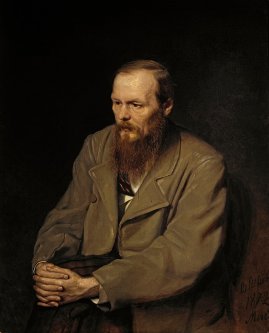
Fyodor Dostoevsky
Psychological depth and moral crisis under pressure; fiction that tests conscience, freedom, and society.
If this one stays with you…

The Voyage OutVirginia Woolf

Jacob's RoomVirginia Woolf

UlyssesJames Joyce

Pierre et JeanGuy de Maupassant
From Crime and Punishment
I did not bow down to you, I bowed down to all the suffering of humanity.
Human nature is not taken into account, it is excluded, it’s not supposed to exist! … They believe that a social system that has come out of some mathematical brain is going to organise all humanity at once and make it just and sinless in an instant, quicker than any living process! … The living soul demands life; the soul won’t obey the rules of mechanics.
But all at once, in that same moment, she understood everything. Infinite happiness lit up in her eyes; she understood, and for her there was no longer any doubt that he loved her, loved her infinitely, and that at last the moment had come. . . .
Pain and suffering are always inevitable for a large intelligence and a deep heart. The really great men must, I think, have great sadness on earth.
To go wrong in one's own way is better than to go right in someone else's.